More Than Fashion: A Jacket Built Around Speed
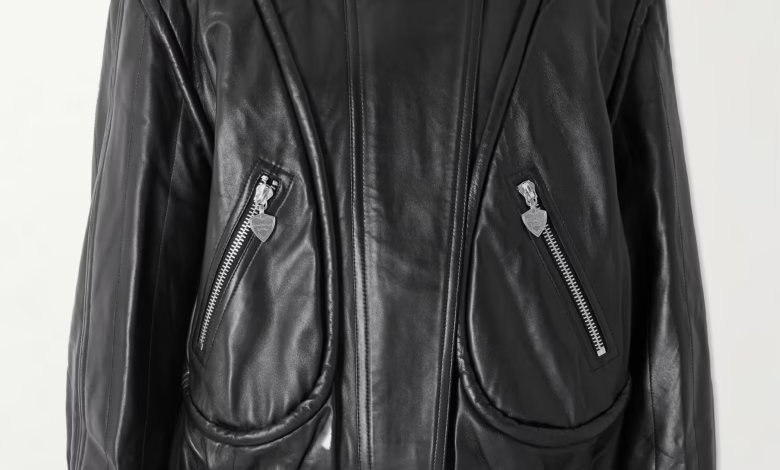
The Leather Biker Jacket did not originate as a fashion item. It emerged from a practical need: protection at high speed on early motorcycles. Before it became a cultural symbol, it was a piece of protective equipment designed for riders exposed to wind, debris, and road impact without modern safety systems.
What makes it interesting today is not just how it looks, but how its original purpose still defines its structure. Even in fashion contexts, it retains the language of motion—tight fit, rigid material, and functional minimalism.
It is one of the few garments where aesthetics directly grew out of engineering requirements.
The Material Logic of Leather in Motion
Leather is not used in biker jackets because it is fashionable. It is used because it behaves predictably under stress.
When a rider moves at speed, air pressure becomes a physical force. Fabric flaps, stretches, or tears. Leather resists that instability. It holds shape while still allowing controlled flexibility.
This is why the Leather Biker Jacket has a dense, structured surface rather than a soft drape. It is designed to reduce environmental interference—wind, friction, and abrasion.
Over time, the material also adapts to the wearer’s body. Instead of degrading, it develops a worn texture that reflects movement history. This aging process is not accidental; it is a byproduct of natural material behavior under repeated stress.
Structural Design: Everything Serves Stability
Unlike modern jackets that often prioritize lightweight construction, the Leather Biker Jacket is intentionally compact and firm.
Key structural elements exist for functional reasons:
- The asymmetric zipper reduces wind penetration at the chest line
- The stiff collar protects the neck during high-speed movement
- The fitted waist prevents fabric lift while riding
- Reinforced shoulders and elbows support repeated friction zones
These features are not decorative additions. They are responses to physical conditions experienced during riding.
Even the jacket’s cropped length is practical—it prevents excess material from interfering with seat position or bike controls.
From Road Gear to Cultural Identity
The transition of the Leather Biker Jacket into mainstream culture did not happen through design change. It happened through visibility.
As motorcycles became associated with independence and rebellion, riders naturally carried their gear into public life. The jacket became a visual extension of that identity.
Cinema amplified this effect. Characters wearing leather biker jackets were often framed as outsiders, anti-establishment figures, or individuals operating outside conventional systems. Over time, the jacket absorbed those meanings.
What is important here is that the garment itself did not change. Its cultural interpretation did.
Why It Still Feels Relevant Today
Despite decades of fashion evolution, the Leather Biker Jacket has not lost relevance. This is because it is not dependent on trend cycles—it is anchored in function-driven design.
Modern clothing often shifts with seasonal aesthetics. The biker jacket does not need reinterpretation to remain visually strong. Its structure already communicates clarity: protection, mobility, and controlled aggression.
Another reason for its persistence is adaptability. While originally designed for riding, it integrates easily into everyday wear without losing its identity. It does not become something else when removed from the motorcycle context—it simply becomes less functionally loaded.
Styling Without Diluting Its Identity
The challenge with wearing a Leather Biker Jacket is not styling it—it is avoiding overcomplication.
Because the jacket already carries strong visual weight, it works best when paired with restrained clothing. Simple trousers, plain shirts, or minimal footwear allow the jacket to remain the dominant visual element.
When over-layered or combined with equally aggressive pieces, the result can become visually noisy. The jacket’s strength lies in contrast, not competition.
Interestingly, it can function in both casual and semi-structured environments, but it always anchors the outfit rather than blending into it.
The Aging Process: A Visible Record of Use
One of the most defining characteristics of a Leather Biker Jacket is how it changes over time.
Unlike synthetic materials that degrade uniformly, leather evolves unevenly based on movement, exposure, and handling. Creases form where the body bends. Color deepens where friction is constant. Surface texture becomes more complex with wear.
This creates a kind of physical memory embedded in the garment. Two jackets of the same model will never look identical after extended use.
This unpredictability is part of its appeal—it reflects lived experience rather than manufactured consistency.
Conclusion: A Functional Object That Became Symbolic
The Leather Biker Jacket stands at the intersection of engineering and identity. It began as a solution to physical problems faced by riders, but over time it accumulated cultural meaning far beyond its original purpose.
What keeps it relevant is not reinvention, but stability. Its design principles remain unchanged because they were already optimized for real-world conditions.
In a fashion landscape that constantly redefines itself, the Leather Biker Jacket remains anchored in something more fundamental: motion, protection, and presence.