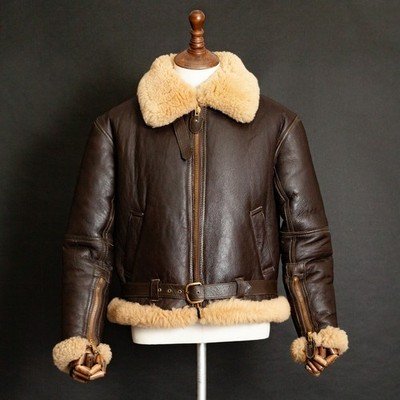
When Clothing Was Built Like Machinery
The B-3 Bomber does not originate from fashion logic. It comes from an era when clothing was treated as survival equipment for aviation crews operating in conditions that modern travel has eliminated. Instead of aesthetics guiding design, environmental pressure dictated every decision.
In unpressurized aircraft cabins of the early 20th century, pilots were exposed to freezing temperatures, strong winds, and long exposure times at high altitude. The B-3 Bomber was engineered as a response system to that environment, not as a style experiment.
Understanding it requires stepping away from modern clothing expectations entirely. It is closer to protective gear than apparel in its original context.
Material Philosophy: Why Natural Insulation Won
The defining characteristic of the B-3 Bomber is its reliance on shearling sheepskin, a material chosen not for luxury but for performance under stress.
Shearling behaves differently from synthetic insulation. Instead of relying on manufactured fibers or hollow structures, it uses natural wool density to trap heat in irregular air pockets. This creates a stable thermal environment that adapts to body temperature fluctuations.
The leather exterior is equally important. It functions as a passive barrier against wind penetration and moisture, while also providing structural rigidity. Unlike modern coated fabrics, it does not aim to be lightweight—it aims to be resistant.
The combination creates a system where insulation and protection are physically integrated, not layered.
Structural Design: Everything Has a Reason
Unlike modern jackets where design elements often serve dual roles (branding + function), the B-3 Bomber’s components are strictly utilitarian.
The oversized collar is not decorative. It is a thermal shield designed to protect exposed skin at high altitudes. The heavy seams are not stylistic stitching—they reinforce stress points caused by movement in rigid conditions.
Even the jacket’s volume is intentional. Air trapped between layers contributes directly to insulation efficiency. Reducing bulk would reduce performance.
This makes the B-3 Bomber unusual in contemporary fashion terms: it cannot be “streamlined” without changing its core function.
The Jacket as a Physical System, Not a Garment
Most clothing today is designed around flexibility, comfort, and visual identity. The B-3 Bomber operates differently. It behaves more like a closed environmental system.
Once worn, it creates a controlled microclimate around the body. Heat retention, wind resistance, and material density all work together without requiring adjustment from the wearer.
This is why it feels heavy compared to modern jackets. That weight is not inefficiency—it is part of the system’s thermal stability.
Thinking of it as “outerwear” is technically incomplete. It is more accurate to describe it as portable insulation architecture.
Transition Into Cultural Visibility
The movement of the B-3 Bomber from aviation equipment to civilian wear did not involve redesign or marketing strategy. It happened through reuse.
Pilots continued wearing their issued jackets after service, and the garment’s visual intensity made it noticeable in everyday environments. Over time, it became associated with durability and lived experience rather than fashion cycles.
Later cultural adoption—especially in film and photography—amplified its identity. It became shorthand for isolation, resilience, and mechanical-era authenticity.
Importantly, this transformation did not alter its structure. The object stayed the same; only its meaning shifted.
Why Modern Adaptations Never Fully Replace It
Attempts to modernize the B-3 Bomber often reduce its thickness or replace shearling with synthetic alternatives. While these versions improve mobility, they fundamentally change the thermal behavior.
The original jacket resists modernization because its design depends on material mass and natural insulation properties. Removing those elements makes it visually similar but functionally different.
This is why heritage versions continue to be valued—they maintain the original engineering logic intact.
Styling Logic in Contemporary Contexts
Using a B-3 Bomber today requires understanding its visual dominance. It does not sit quietly in an outfit; it defines the outfit’s structure.
Because of its weight and texture, pairing it with minimal clothing works best. Neutral tones, simple silhouettes, and unlayered compositions allow its form to remain readable rather than visually overloaded.
Interestingly, it often introduces balance to modern lightweight fashion trends. Where contemporary outfits emphasize thinness and flexibility, the B-3 Bomber reintroduces density and physical presence.
Conclusion: A Design That Refuses Obsolescence
The B-3 Bomber persists not because it is periodically reinvented, but because its original design logic remains intact and functional.
It represents a category of objects built under extreme necessity, where performance mattered more than appearance. That origin gives it a permanence that trend-based clothing rarely achieves.
Even in a world of advanced textiles and algorithm-driven design, the B-3 Bomber remains unchanged in principle: a physical solution to cold, wind, and altitude—still readable, still functional, and still structurally honest.