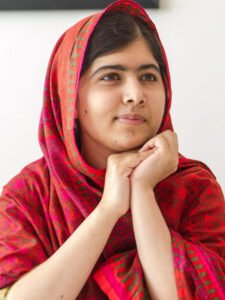
Malala Yousafzai biography is a powerful story of courage, education, and resilience. She is known worldwide as a symbol of girls’ education and human rights. From a small town in Pakistan to global recognition, Malala’s journey has inspired millions of people across the world.
Malala Yousafzai is the youngest Nobel Peace Prize winner in history. Her life proves that one voice, even at a young age, can challenge injustice and create global change.
Early Life and Family Background
Malala Yousafzai was born on July 12, 1997, in Mingora, Swat Valley, Pakistan. She comes from a Pashtun family that deeply valued education. Her father, Ziauddin Yousafzai, is an educator and social activist who played a major role in shaping Malala’s mindset.
From a very young age, Malala showed curiosity and confidence. She loved reading, learning, and speaking openly about social issues. Unlike many girls in her region, she was encouraged to attend school and express her opinions freely.
Her home environment focused strongly on education, equality, and freedom of speech, which later became the foundation of her activism.
Education and Early Activism
Malala studied at the Khushal School, which was run by her father. When the Taliban began restricting girls’ education in Swat Valley, Malala became deeply concerned.
At just 11 years old, she started writing a blog for the BBC Urdu under a pen name. In her blog, she described life under Taliban rule and the fear of losing access to education. Her writing was honest, emotional, and brave.
This marked the beginning of Malala’s public journey as an education activist.
Taliban Attack and Survival
In October 2012, Malala Yousafzai was targeted by the Taliban. While returning home from school on a bus, she was shot in the head because she spoke out for girls’ education.
The attack shocked Pakistan and the entire world. Malala was critically injured and flown to the United Kingdom for emergency treatment. Against all odds, she survived.
Instead of silencing her, the attack amplified her voice globally.
Global Recognition and Nobel Peace Prize
After her recovery, Malala continued her activism with even greater determination. In 2013, she addressed the United Nations, delivering a powerful speech on education and peace.
In 2014, Malala Yousafzai received the Nobel Peace Prize at the age of 17, becoming the youngest Nobel laureate ever. She shared the prize with Kailash Satyarthi, an Indian children’s rights activist.
The Nobel Committee honored her for:
- Her fight against the suppression of children
- Her advocacy for girls’ right to education
Her achievement became a historic moment for Pakistan and the global education movement.
Higher Education and Academic Achievements
Malala pursued higher education despite global fame. She studied Philosophy, Politics, and Economics (PPE) at the University of Oxford, one of the world’s most prestigious universities.
In 2020, she graduated successfully, proving her commitment to education not only as an activist but also as a student.
Her academic journey further strengthened her credibility as a global leader and role model.
Malala Fund and Ongoing Work
Malala is the co-founder of the Malala Fund, a non-profit organization dedicated to ensuring 12 years of free, safe, and quality education for every girl.
The organization works in multiple countries, including:
- Pakistan
- Afghanistan
- Nigeria
- India
- Brazil
Through policy advocacy, funding local educators, and global campaigns, Malala continues to influence education systems worldwide.
Books and Media Presence
Malala has authored several influential books. Her autobiography, “I Am Malala”, became an international bestseller and has been translated into many languages.
Her writing focuses on:
- Education
- Equality
- Peace
- Women’s rights
Malala also actively participates in international conferences, interviews, and documentaries, keeping education at the center of global discussions.
Personal Life and Marriage
In 2021, Malala married Asser Malik, a development professional. Despite public attention, she maintains a private personal life while continuing her global mission.
She balances advocacy, education, and personal growth with remarkable maturity and grace.
Why Malala Yousafzai Matters Today
The Malala Yousafzai biography is not just a life story—it is a global lesson in courage. She represents hope for millions of girls who still struggle to access education.
Her impact goes beyond awards. She has influenced policies, inspired youth movements, and changed how the world views girls’ education.
Conclusion
Malala Yousafzai’s life is a reminder that education is power. From surviving an assassination attempt to standing on the world’s biggest stages, her journey is nothing short of extraordinary.
Her story continues to inspire students, activists, and leaders around the world. The Malala Yousafzai biography proves that age, gender, and fear can never stop a determined voice from changing the world.