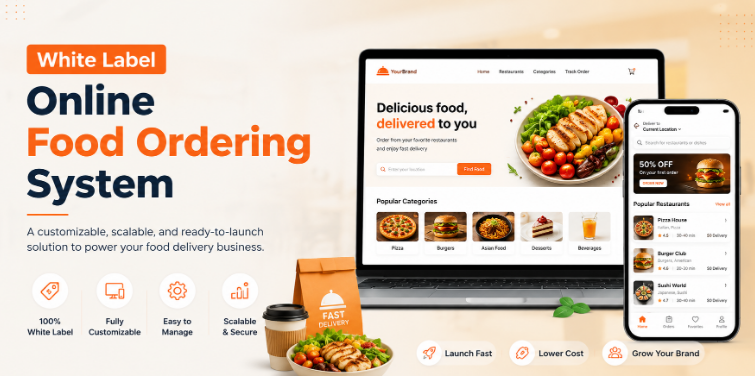
The restaurant industry has undergone a major digital transformation in recent years. Customers now expect convenient ordering experiences, faster delivery options, real-time updates, and personalized services. While traditional phone-based ordering and third-party marketplaces helped restaurants reach customers, many businesses are now exploring more flexible digital solutions that give them greater control over their operations.
A white label online food ordering system has emerged as a practical solution for restaurants looking to build their own branded ordering platforms without developing everything from scratch. These systems allow restaurants to offer online ordering through their own website or mobile application while managing customer relationships, orders, payments, and marketing activities directly.
Beyond improving convenience, a white-label solution can help restaurants increase revenue by reducing dependency on external platforms, improving customer engagement, and creating additional sales opportunities. This article explores how these systems work and why they are becoming an important part of modern restaurant growth strategies.
What Is a White Label Online Food Ordering System?
A white label online food ordering system is a ready-made digital ordering platform that businesses can customize and launch under their own brand name. Instead of building a food ordering website or application from the ground up, restaurants can use an existing framework and modify elements such as branding, colors, menus, payment options, and customer features.
These systems typically include essential features such as:
- Online menu management
- Customer ordering interface
- Digital payment integration
- Order tracking
- Restaurant management dashboard
- Customer notifications
- Sales analytics
- Marketing tools
For restaurants, this approach provides a faster way to establish a digital ordering channel while maintaining ownership of their brand identity and customer experience.
Unlike marketplace platforms where customers interact mainly with the marketplace brand, a restaurant using its own branded ordering system can create direct relationships with customers. This direct connection can play an important role in improving repeat purchases and long-term revenue.
Growing Importance of Direct Online Ordering for Restaurants
Third-party food delivery platforms have helped restaurants expand their reach, but they also create challenges. Many restaurants depend heavily on these platforms for customer acquisition, which can reduce profit margins due to commissions and service fees.
A direct ordering channel gives restaurants more control over:
- Customer data
- Branding opportunities
- Promotional campaigns
- Pricing strategies
- Customer communication
A white label food delivery app enables restaurants to provide customers with a familiar ordering experience while keeping interactions connected to their own brand. This allows businesses to encourage repeat orders and develop stronger customer loyalty.
As customers become more comfortable with digital ordering, having a dedicated online presence is becoming less of an option and more of a necessity for many food businesses.
Ways a White Label Online Food Ordering System Helps Increase Revenue
1. Reduces Dependency on Third-Party Marketplaces
One of the biggest advantages of adopting a branded ordering platform is reducing reliance on external food delivery marketplaces.
Third-party platforms can provide visibility and access to new customers, but restaurants often have limited control over customer relationships. The platform owns much of the customer interaction, while restaurants operate within the marketplace’s ecosystem.
A white label online food ordering system allows restaurants to build their own ordering channel. Customers can place orders directly through the restaurant’s website or application, helping businesses retain more control over revenue generation.
By encouraging customers to order directly, restaurants can potentially reduce commission-related expenses and improve overall profitability.
2. Creates Opportunities for Repeat Orders
Customer retention is one of the most important factors affecting restaurant revenue. A customer who orders repeatedly provides more long-term value compared to a one-time customer.
A branded ordering platform allows restaurants to maintain direct communication with customers through:
- Order history tracking
- Personalized recommendations
- Loyalty programs
- Discounts
- Push notifications
- Special offers
For example, restaurants can analyze customer preferences and promote relevant menu items. A customer who frequently orders vegetarian meals may receive suggestions for new vegetarian dishes or special offers related to their preferences.
This personalized approach can increase order frequency and average customer value.
3. Improves Customer Experience
Customer experience directly influences purchasing decisions. A complicated ordering process can lead to abandoned carts, while a smooth digital experience encourages completed purchases.
A well-designed white label food delivery app can provide features that improve convenience, including:
- Easy menu navigation
- Quick search options
- Multiple payment methods
- Real-time order updates
- Saved addresses
- Faster checkout
When customers find ordering simple and reliable, they are more likely to return. Improved convenience can contribute to higher customer satisfaction and increased sales.
4. Supports Better Brand Recognition
Building a recognizable brand is important for restaurants operating in competitive markets. When customers repeatedly interact with a restaurant’s own application or ordering website, the brand becomes more familiar.
A white label solution allows restaurants to maintain consistent branding across their digital channels. This includes:
- Restaurant logo
- Brand colors
- Menu presentation
- Promotional messages
- Customer communication
Over time, customers may associate the ordering experience directly with the restaurant rather than with a third-party platform.
Strong brand recognition can help restaurants create customer loyalty and improve their ability to attract repeat business.
Increasing Revenue Through Data-Driven Decisions
One of the major benefits of digital ordering platforms is access to business insights. Traditional ordering methods often provide limited information about customer behavior, while online systems can collect valuable operational data.
A restaurant can analyze:
- Best-selling menu items
- Peak ordering times
- Customer preferences
- Average order value
- Repeat customer patterns
- Promotional performance
These insights help restaurants make informed decisions about menu planning, pricing, inventory management, and marketing strategies.
For example, if analytics show that certain items are frequently purchased together, restaurants can create combination offers or meal packages to increase average order value.
Data-driven decision-making allows restaurants to focus resources on strategies that have a higher chance of improving revenue.
The Role of Multi-Vendor Food Delivery Platforms
While individual restaurants benefit from branded ordering solutions, entrepreneurs and larger food businesses may explore broader marketplace models.
A multi-vendor food delivery app allows multiple restaurants, cafes, and food providers to operate through a single platform. These systems are commonly used by businesses that want to create a food marketplace similar to large delivery platforms.
Multi-vendor platforms can generate revenue through different models, including:
- Restaurant commissions
- Delivery charges
- Subscription plans
- Advertising opportunities
- Featured listings
For businesses planning to build a larger food delivery ecosystem, working with experienced top food delivery app development companies can help them understand the technical requirements, scalability options, and essential features needed for such platforms.
However, restaurants choosing a direct ordering strategy may find a white label system more suitable because it focuses on strengthening their own brand and customer relationships.
Features That Make White Label Ordering Systems Effective for Revenue Growth
A white-label online food ordering system includes various features designed to improve restaurant operations and enhance customer engagement. While features may differ between platforms, several capabilities are particularly valuable for increasing revenue.
1. Mobile-Friendly Ordering Experience
Most customers prefer using smartphones for online purchases, including food orders. A responsive website or dedicated application ensures customers can browse menus, customize orders, and complete payments easily from any device.
A mobile-friendly ordering experience helps restaurants capture more customers who prefer quick and convenient ordering options. Faster navigation and a smoother checkout process can also reduce abandoned orders.
2. Digital Menu Management
Menu presentation has a direct impact on customer purchasing decisions. Digital ordering platforms allow restaurants to update menus instantly, add new dishes, modify prices, and highlight special items.
Restaurants can use digital menus to:
- Promote seasonal dishes
- Highlight popular meals
- Add attractive food descriptions
- Display images
- Create meal combinations
A well-organized digital menu can encourage customers to explore more options and increase their average order value.
3. Multiple Payment Options
Customers expect flexibility when making payments. A white label ordering platform can support different payment methods, including digital wallets, cards, and online payment gateways.
Providing multiple payment choices improves convenience and reduces friction during checkout. A smoother payment experience can increase completed orders and improve customer satisfaction.
4. Order Tracking and Notifications
Customers appreciate transparency after placing an order. Features such as real-time order updates, preparation status, and delivery tracking help create a better experience.
Notifications can also be used for customer engagement, such as:
- New menu announcements
- Discount alerts
- Loyalty rewards
- Order confirmations
Effective communication keeps customers connected with the brand and encourages repeat purchases.
5. Customer Loyalty Programs
Loyalty programs are commonly used by restaurants to increase customer retention. A branded ordering platform can include reward systems that encourage customers to order more frequently.
Examples include:
- Points-based rewards
- Discount coupons
- Membership benefits
- Referral incentives
These programs can motivate customers to choose the restaurant’s own ordering platform instead of searching through multiple food marketplaces.
How Restaurants Can Increase Average Order Value
Increasing revenue is not only about gaining more customers; it is also about maximizing the value of each order. A white-label online food ordering system can support strategies that encourage customers to spend more.
Personalized Recommendations
Digital platforms can analyze ordering patterns and suggest relevant items. For example, customers ordering a main course may receive recommendations for beverages, desserts, or side dishes.
These suggestions can increase the likelihood of additional purchases without creating a complicated ordering experience.
Upselling and Cross-Selling
Online ordering systems can display recommendations during the ordering process.
Examples include:
- Adding extra toppings
- Upgrading meal sizes
- Combining items into packages
- Suggesting complementary products
These small improvements can gradually increase the average order value.
Special Promotions
Restaurants can create targeted promotions based on customer behavior. Instead of offering the same discount to everyone, businesses can provide offers that match customer interests.
Examples include:
- Weekend meal deals
- First-order discounts
- Loyalty rewards
- Limited-time menu offers
A direct ordering platform gives restaurants more flexibility in designing and managing these campaigns.
White Label Solutions and Restaurant Scalability
Growth often creates operational challenges for restaurants. Managing increased order volumes, multiple locations, and customer expectations requires efficient technology.
A white-label platform can support scalability by providing tools for:
- Multiple branch management
- Centralized order control
- Inventory coordination
- Sales reporting
- Customer management
For restaurant chains, this can create a consistent ordering experience across different locations while allowing individual branches to manage their operations.
Scalable systems are also useful for businesses planning future expansion because they can add new features and integrations as requirements change.
Choosing the Right Food Delivery App Development Partner
Businesses interested in creating a customized ordering solution often evaluate different technology providers. Selecting the right food delivery app development company can influence the quality, performance, and scalability of the final platform.
Important factors to consider include:
Technical Expertise
A development partner should understand food delivery industry requirements, including restaurant management systems, payment integration, customer applications, and delivery workflows.
Customization Options
Although white label solutions provide a ready-made foundation, businesses may require customization to match their operational needs. Flexible platforms allow restaurants to add specific features and maintain their unique brand identity.
Security and Reliability
Online ordering platforms handle sensitive information, including customer details and payment transactions. Strong security practices and reliable infrastructure are important for maintaining customer trust.
Scalability Support
A solution should be capable of supporting future growth. Businesses should consider whether the platform can handle increasing users, additional restaurants, higher order volumes, and new locations.
Many organizations compare different providers, including top food delivery app development companies, to evaluate experience, technology capabilities, and industry understanding before selecting a suitable partner.
White Label Online Food Ordering System vs Traditional Ordering Methods
Traditional ordering methods, such as phone calls and manual order processing, can still work for some businesses, but they have limitations when customer expectations become more digital.
| Traditional Ordering | White Label Online Ordering |
| Limited ordering hours | Available 24/7 |
| Manual order management | Automated order processing |
| Less customer data | Better customer insights |
| Limited marketing opportunities | Direct promotional capabilities |
| Higher chances of communication errors | Digital order accuracy |
A digital ordering system does not necessarily replace every traditional method, but it provides an additional channel that can help restaurants serve customers more efficiently.
Future of White Label Food Ordering Solutions
The food technology industry continues to evolve as customers demand faster, simpler, and more personalized experiences. Future ordering platforms are expected to incorporate more advanced capabilities, such as:
- Artificial intelligence-based recommendations
- Voice-enabled ordering
- Advanced customer analytics
- Automated marketing tools
- Improved delivery management
A white label food delivery app can help businesses adapt to these changes by providing a flexible foundation that can be updated as technology develops.
Restaurants that invest in digital ordering capabilities can better respond to changing customer behavior and create stronger connections with their audience.
Conclusion
A white label online food ordering system provides restaurants with a practical way to establish their own digital ordering channel while improving customer engagement and revenue opportunities. By reducing dependency on third-party marketplaces, supporting direct customer relationships, and enabling data-driven strategies, these platforms can become valuable tools for modern restaurant growth.
From personalized recommendations and loyalty programs to improved ordering experiences and operational efficiency, white label solutions offer multiple ways for restaurants to increase sales and strengthen their brands.
As online food ordering continues to grow, restaurants that focus on convenience, customer relationships, and digital innovation will be better positioned to compete in an increasingly technology-driven market.